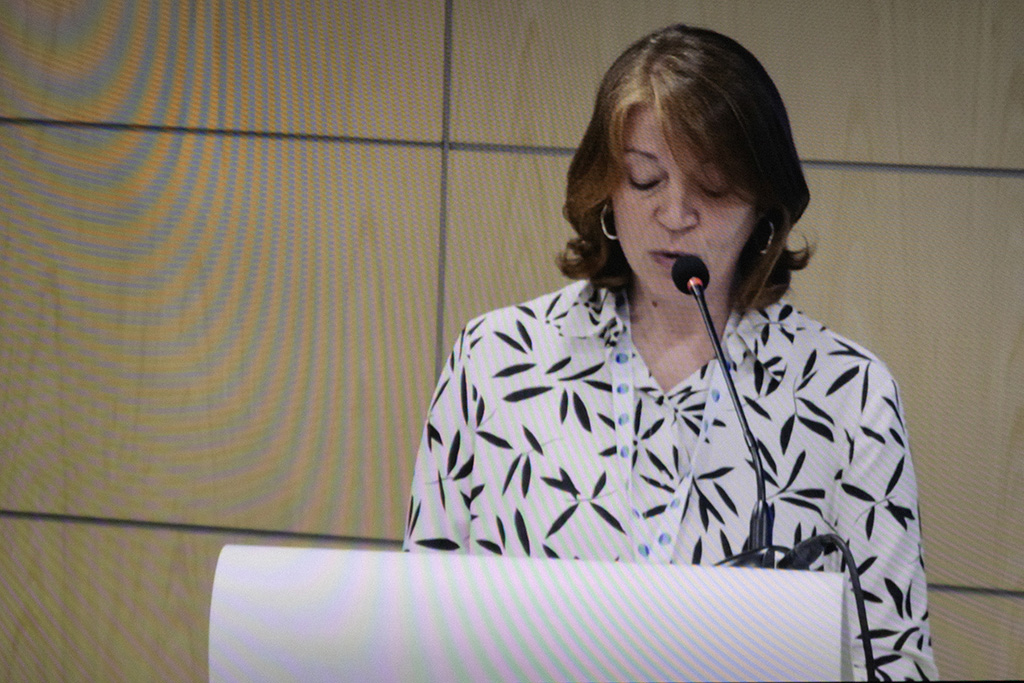
Milan, 14 May 2025 – ReCommon intervened for the first time at the Snam shareholders’ meeting as a “critical shareholder” to ask the company’s management to end its controversial relations with private Israeli companies.
Since December 2021, in fact, Snam controls 25% of the East Mediterranean Gas Company (EMG), the company that owns the Arish-Ashkelon gas pipeline connecting Israel with Egypt. This is a 90-kilometre pipeline that since 2020 has been used by Israel to export gas extracted from the Tamar and Leviathan offshore fields to Egypt, gas that Egypt then uses or resells in other markets.
EMG’s shareholders, in addition to Snam, include EMED Pipeline BV, owned by: 25% EMED Pipeline Holding Limited (100% owned by NewMed Energy); 25% Chevron Cyprus Limited; 50% Sphinx EG BV (100% owned by East Gas Company S.A.E.). NewMed Energy (formerly known as Delek Drilling) is part of the Delek group and one of the companies active not only in offshore extraction, but also in the Palestinian occupied territories. According to data provided by Snam itself, Snam’s pro-rata profit generated by the shareholding in EMG from 2023 to Q1 2025 is €18 million.
Previously, in October 2020, Snam had signed three memorandums of understanding with the Isrealian companies Delek Drilling and Dan on liquefied natural gas (LNG) for public transport; with Dan on the development of green mobility projects and with the start-up H2Pro on hydrogen research.
We have made very concrete requests to Snam: to sell the shares in EMG; to withdraw from any existing contracts and/or agreements with the Israeli government and companies in the country – including NewMed Energy Group, Dan, H2Pro and other Israeli companies – as long as there are serious doubts about respect for human rights and international law; to undertake thorough due diligence on partners active in contexts of occupation and conflict; and to adopt a binding policy on respect for rights in international operating contexts, in line with the UN Guiding Principles on Business and Human Rights.
It is now up to Snam to decide for consistency and compliance.
‘The company’s public image and reputation would be at stake if it were to be publicly associated with acts that could be construed as war crimes,’ said Elena Gerebizza of ReCommon.
ReCommon attended the shareholders’ meeting of Snam, one of the very few Italian companies to no longer hold these important meetings behind closed doors, also to highlight its strong concerns about the situation in Tunisia, linked to the SouthH2Corridor project, and the Ravenna CCS, co-promoted by Snam and Eni.
What is also known in Italy as the Southern Hydrogen Corridor is a 3,300-kilometre-long infrastructure that should run from North Africa to Germany, passing through Italy, to transport hydrogen produced largely in Tunisia, where repression by the executive is currently affecting all sectors of civil society far and wide. One of the pivotal projects of the Mattei Plan is therefore already marked by heavy criticalities, of which ReCommon has asked Snam for an account.
The extractive model on which Snam’s business is based is also confirmed by the uncertainty over the possible transfer of the Piombino FSRU to Vado Ligure and Sardinia’s methanisation plans. Despite the fact that the Italian Regulatory Authority for Energy Networks and Environment (ARERA) has suspended the key infrastructures planned for the island for reasons of cost and inefficiency, the almost final draft of the Energy decree (DPCM Energia) insists on obsolete fossil energy infrastructures: FSRU in Porto Torres and Oristano, mini gas backbone and LNG transport by road with a virtual pipeline financed entirely with public money.
‘Snam’s plan for Sardinia appears anachronistic and contrary to the principles of a just transition: it invests in expensive fossil infrastructures, already contested by ARERA, in a context of uncertain and declining gas demand, with the real risk of generating stranded assets and aggravating the economic burden on citizens,’ said Paola Matova of ReCommon.