In December 2024, anyone about to take a train could come across a digital totem pole with the caption “Climate risks: how much is your company’s future worth?”. The advertising campaign, featured in fourteen Italian railway stations, promoted “Climate Risk Protection”, a new insurance product from SACE aimed at companies.
SACE is the Italian export credit agency, controlled by the Ministry of Economy and Finance. These agencies issue “classic” insurance policies or loan guarantees, i.e. insurance for the benefit of a bank. If something goes wrong, SACE reimburses companies or banks that have lent capital for their projects, in both cases with public money. Organisations such as SACE were set up to promote the export of companies in a given country, but in recent years – due to the economic crises triggered first by the pandemic and then by the Russian invasion of Ukraine – their operations have also grown strongly at a domestic level.
In the same days that SACE promoted “Climate Risk Protection”, the agency issued a guarantee on loeans worth approximately €660 million for the Sakarya Phase II project, which concerns the «construction of 10 additional wells for the extraction of natural gas from the offshore field of the same name […] in the Turkish Exclusive Economic Zone of the Black Sea». In May 2023, SACE had already financially supported the first phase of the project with a €243 million guarantee, a project that will contribute to the emission into the atmosphere of 140 million tonnes of CO2equivalent: approximately those produced by Qatar in 2023. The second phase could contribute double the emissions.
However, this is hardly surprising: despite its attempts to present itself in the service of the environment and the climate, it is SACE’s operations that make Italy the leading public financier of fossil fuels in Europe and the fifth globally. The recent guarantee issued for Sakarya is therefore part of a long-standing roadmap.
Some analysts describe Sakarya as «the largest discovery in the Black Sea», with reserves amounting to 710 billion cubic metres of gas. From the wells in the Black Sea, which came into operation in the autumn of 2023, the gas arrives at the Filyos (Zonguldak) facility via a pipeline of approximately 170 kilometres laid at a depth of 2,200 metres, and from there to the national distribution network.
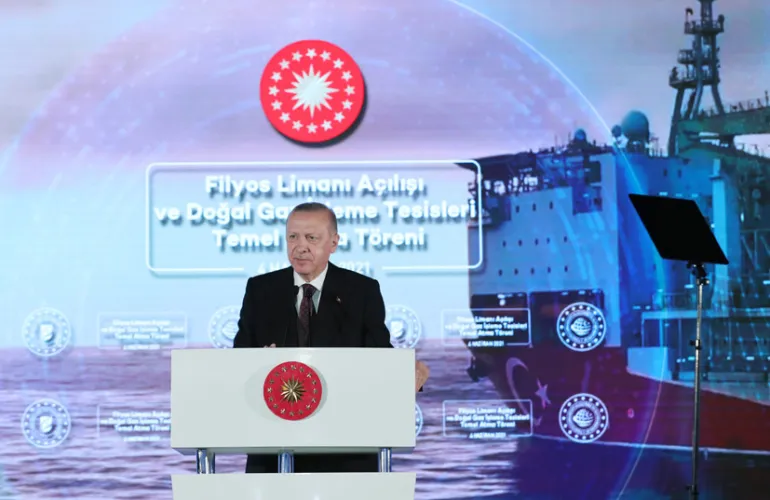
In April 2023, one month before the presidential elections in Turkey, Erdoğan himself inaugurated the arrival of the first cubic metres of gas at the Filyos plant. A project that embodies Turkey’s ambition to free itself from dependence on Russian gas and even present itself on the market as an exporter. Ankara says that the first phase – which should be completed in the next few days – is intended to reach a daily production of 10 million cubic metres of gas. However, according to data updated to January 2025 by the Turkish Energy Market Regulatory Authority, this still stands at 6.5. The target of reaching 40 million cubic metres of gas per day in the second phase and 60 by 2028 seems more like a wish than a figure based on accurate analysis, downplaying the wishful thinking that Sakarya should supply domestic consumption, while exports to Europe are never mentioned in the official narrative. In fact, official data show that Italy has not received a single cubic metre of gas produced in Turkey directly, an element that strongly clashes with certain clauses in SACE’s climate policy. Also because of these clauses SACE has the weakest climate policy among export credit agencies, being able to guarantee fossil fuel projects with public money practically forever.
And this is not only a climate issue, but also a problematic use of public resources. According to a recent study by Carbon Tracker, the energy transition will lead to the more or less rapid replacement of oil and gas, and the resulting drop in demand will contribute to lower commodity prices. As a result, hydrocarbon production, transport and storage projects risk generating profits below the minimum rate of return, increasing the risk of insolvency on the part of proponent companies. This is no small problem when projects are guaranteed by institutions such as SACE, which are increasingly exposed to the risk of having to shell out public money to protect commercial banks or fossil fuel companies.
The only way for these projects to be profitable is for the ecological transition to proceed even slower than the current pace, condemning the Planet and the people who inhabit it to terrifying and increasingly tangible consequences. A real gamble, whichever way you look at it.
Of the 10 projects analysed by Carbon Tracker, as many as 7 see the presence of SACE, with a moderate credit risk in the hands of the institution. These include TotalEnergies’ Mozambique LNG, for which the Italian government recently confirmed SACE’s financial support. A support that comes despite the long shadows of human rights violations that can amount to potential war crimes, carried out by the Mozambican army to protect the site. If independent investigations were to confirm these events, the consequences would also fall on financial institutions.
The operations of agencies such as SACE therefore not only concern the health of the Planet, but also the protection of human rights and the sustainability of Italy’s public coffers. The time has come for institutional politics to take action, before the repercussions are irreparable.