What is SACE’s position on the war in Ukraine, in light of its exposure to Russian business, particularly in strategic sectors such as oil, gas and petrochemicals?
Will it behave in a similar way to its German counterpart Euler Hermes, which a few days ago decided to stop providing new guarantees for projects and investments in Russia? These are the questions that ReCommon is asking the Italian public export credit agency, the public insurer that covers Italian multinationals against political and commercial risks in their export and foreign investments.
Russia is one of the main markets where SACE operates. As at 30 June 2020, the total exposure was around EUR 4.3 billion: the seventh largest country in terms of the agency’s operations globally. In the two-year period 2018-2019, SACE guaranteed 108 new operations in Russia, for a total amount of approximately EUR 2.1 billion. Of these, €1.3 billion for the implementation of a major project in the oil&gas sector. Even in 2020, characterised by the impact of the pandemic on trade relations between Italy and Russia, €230 million of the €237 million in guaranteed operations concerned the hydrocarbons sector.
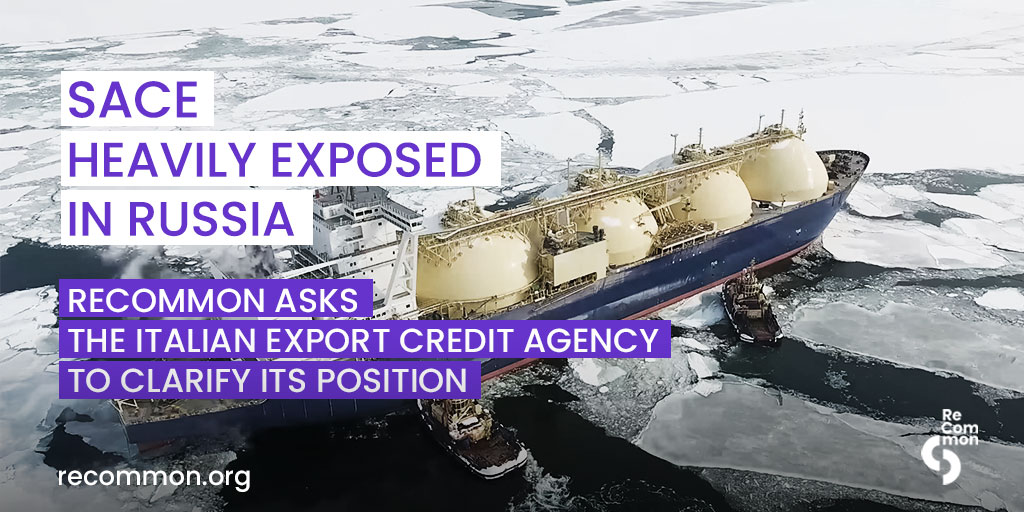
Among the beneficiaries are the big names of the so-called ‘Sistema-Italia’, active in various sectors, operating in Russia. But there are also large Russian corporations active in the fossil fuels sector. Among the main operations guaranteed by SACE in Russia in recent years, we recall in 2016 the Yamal LNG megaproject of the Russian company Novatek, in joint venture with Total, for a total of EUR 400 million. In this case, SACE guaranteed part of Intesa Sanpaolo’s loan, which amounted to a total of €750 million.
Same fate – and same players – for Arctic LNG-2, although the export credit agencies of France and Germany pulled out of the agreement. An operation guaranteed by SACE between two fundamental events for climate and the environment: the G20 meeting on Environment, Climate and Energy in Naples and the COP26 in Glasgow, co-chaired by Italy together with the United Kingdom. In this case, the amount guaranteed is around EUR 1 billion, of which at least EUR 500 million again for guaranteeing a loan from Intesa Sanpaolo, for a project with a capacity of around 20 mtpa of liquefied fossil gas. Again with Novatek, SACE could also be approached for the Obsky LNG fossil gas liquefaction plant.
The special relationship between SACE and Novatek is rooted in the strategic cooperation memorandum signed in December 2018, that took place under the supervision of the Italian Ministry of Economic Development, which concerned precisely Arctic LNG-2 and possible new projects in which Italian companies could be involved. «Wouldn’t it be time for SACE to immediately terminate this strategic memorandum with Novatek?», asks Daniela Finamore of ReCommon.
More recently, SACE was involved in the guarantee for the Amur Gas Chemical Complex project of Gazprom, Russia’s main state-controlled energy company, which is the main player when it comes to exporting fossil gas to Europe. The transaction, concluded in December 2021, saw SACE provide a guarantee for part of the total $2.6 billion loan granted by a number of commercial banks.
«SACE’s operations in Russia, dominated by fossil fuels, not only endanger the fate of both climate and the environment», comments Simone Ogno of ReCommon, «but in this case also people, indirectly supporting the Russian Federation’s war effort, financed through oil&gas exports. SACE must immediately stop issuing new guarantees for projects and investments in Russia, as Euler Hermes has done, and block the most recent ones, especially in sectors such as oil&gas that are fuelling the ongoing military offensive in Ukraine», he concludes.
What is SACE
SACE was established as an export credit agency (ECA). ECAs cover a country’s multinationals against political and commercial risks in their exports and foreign investments, especially in countries considered ‘at risk’. The main activity of ECAs, including SACE, is to provide guarantees, i.e. public insurance. Beneficiaries can be multinational companies, whose projects abroad can be insured, and commercial banks, whose loans to companies’ foreign projects can be guaranteed.
If things go wrong, SACE reimburses the companies or banks that lent the companies money for their foreign projects. In both cases with public money. SACE’s operations are 90% co-insured by the Italian Ministry of Economy and Finance, and the remaining 10% of SACE is counter-guaranteed by the State: that way the debt goes from private to public sphere.
Over the past two years, the agency’s mandate has been extended by various legislative acts – notably the so-called DL Liquidità and DL Semplificazioni – to extend its operations to the national level.
The Decree-law ‘Liquidità’ of April 2020 allows SACE to guarantee with public money bank loans to Italian companies in difficulty due to the pandemic operating in Italy, through the “Garanzia Italia” programme. This means that, in the event of insolvency, it will be public money that will settle the debt with banks also for domestic operations, in addition to international ones.
The Decree-law ‘Semplificazioni’ of July 2020 entrusted SACE with the role of issuing guarantees to support projects in the frame of the Italian Green Deal, embodied in the National Recovery and Resilience Plan (PNRR), the Italian part of the NextGeneration EU programme – the temporary instrument designed to boost the European post-pandemic recovery, through the “Green guarantees” programme.
These two legislative acts, renewed by the Draghi government, have reaffirmed that the Italian post-pandemic socio-economic recovery will be entrusted to finance, thanks to the private-public partnership: commercial banks provide the loans and SACE guarantees them, deciding by mutual agreement which companies can benefit and which cannot, what is green and what is not.
Between 19 and 22 January 2022, an interministerial decree was signed between the Italian Ministry of the Economy and Finance (MEF) and the Italian Ministry of Foreign Affairs and International Cooperation, bringing SACE again under the direct control of the MEF, after years formally under Cassa Depositi e Prestiti.
The Italian Court of Auditors, in its report on the 2020 Budget of SACE published on 5 February 2022, expressed its opinion on the radical transformation of the agency, raising questions of the uttermost importance. First of all, the institute highlighted with concern the concentration of operations guaranteed by SACE: 45% the cruise sector, 20% the oi&gas and 7% the petrochemical sector. Secondly, he warned of the future governance of SACE, pointing out that it must be made up of competent people with integrity, with the main objective of differentiating the portfolio of guaranteed operations.
The value of guaranteed oil and gas operations between 2016, the year in which the Paris Climate Agreement came into force, and 2020 is EUR 10.8 billion. With a portfolio of operations in which the fossil industry still accounts for 27%, it is paradoxical that Italy’s ecological transition should pass through SACE.