In the corridors of Brussels, energy transition rhymes with green hydrogen. The European Green Deal identifies the “green” variant – produced with electricity from renewable sources and free of direct CO₂ emissions – as one of the pillars of the decarbonisation of heavy industry, transport and electricity production planned by 2050. With the REPowerEU plan, launched in March 2022 in response to the energy crisis and dependence on Russian fossil fuels, green hydrogen has been elevated to a strategic lever for energy security and the EU’s ecological transition.
Despite the emphasis on European autonomy, however, the plan looks well beyond the Schengen borders: Brussels aims to exploit production sites built along the Southern shore of the Mediterranean, in North Africa. In this scenario, Tunisia emerges as a crucial partner. Already connected to Europe by the Transmed gas pipeline, which links Algeria and Italy, the country is now at the centre of European ambitions to create a hub for the production and export of green hydrogen. During the presidency of Kais Saied, which marks a return to authoritarianism and centralisation of power, closed-door meetings and industrial forums on green hydrogen have multiplied in Tunis.
In May 2024, a government appointed directly by the President, without the inclusion of a parliament now emptied of its representative role, presented Tunisia’s green hydrogen strategy. The goal is to produce 8.3 million tonnes by 2050, of which nearly 6 million will be exported and just over 2 million will be used for the domestic market and derivatives. To achieve this, Tunisia will need to develop around 100 GW of capacity from renewable sources, far exceeding its current installed capacity.

At the heart of the strategy is the SouthH2 Corridor, a 3,300 km mega gas pipeline promoted by Italy’s Snam, which has become a Project of Common Interest at European level, aiming to connect North Africa to Germany and the EU market. According to an agreement between Italy, Germany and Austria, the corridor is expected to become one of the five main axes for importing 10 million tonnes of renewable hydrogen by 2030. However, Tunisia’s plans set the main targets for 2050.
Despite reassurances from Belhassen Chiboub, Director General of Electricity and Energy Transition at the Ministry of Industry, that the energy transition represents a “climate necessity and an economic opportunity” for Tunisia, most of the planned production will not contribute to domestic green energy needs. Yet Tunisia’s national energy mix remains heavily dependent on fossil fuels: 88% of primary energy and 97% of electricity still originate largely from Algerian natural gas.
The European strategy is fuelling growing concerns among civil society and environmental movements, which fear that European needs are being put before local ones. Despite an increasingly repressive climate, demands for real energy sovereignty continue to multiply. In Gabès, a port city in the South-East of the country destined to host the future “green hydrogen valley”, the population is mobilising against a project perceived as extractivist and unfair.
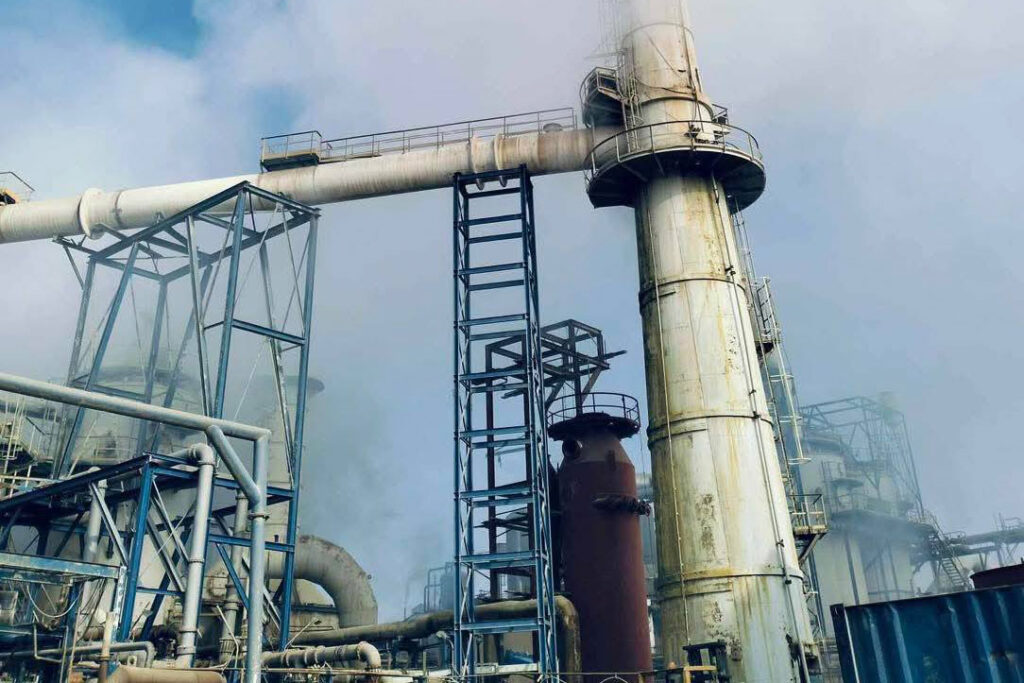
For more than half a century, the city has been suffocated by emissions from the Groupe Chimique Tunisien (GCT), a public group producing phosphate-based fertilisers. Last October, Gabès was the scene of some of the most impressive environmental protests ever recorded in the country, following a health crisis caused by toxic fumes from the group’s plants. Paradoxically, it is precisely the GCT that has been chosen by the government as the pilot site for the first production of green hydrogen in Tunisia.
Gabès, future crossroads of green hydrogen?
Long stuck at the planning stage, Tunisia’s new green hydrogen strategy — often referred to as the future “H2 Valley” — gained momentum in 2024 with the signing of seven memoranda of understanding between the Tunisian government and several foreign companies. Signatories include: HDF Energy (France), Savannah Energy (United Kingdom), DEME Hyport (Belgium), ABO Energy (Germany), a partnership between Amarenco (Franco-Irish) and H2 Global Energy (Zurich), a consortium formed by Verbund (Austria), Aker Horizons (Norway) and TuNur (United Kingdom/Malta), and H2Noto, the largest of all the projects proposed in Tunisia, led by France’s Total Energies, together with Verbund (Austria) and EREN Groupe (Luxembourg).
‘These agreements are not yet binding contracts: they serve primarily to position Tunisia and create a framework of trust. Companies can thus begin preliminary studies, knowing that the country supports the project and is preparing for its future implementation,’ explains a member of the Green Hydrogen Steering Committee at the Ministry of Energy in Tunis. Following these announcements, several other companies have expressed interest in investing in the Tunisian supply chain, including CMMZE (Monaco), which has announced the launch of green hydrogen production projects in South-Eastern Tunisia, and Italy’s Eni and Enel.

The development of green hydrogen projects is in fact mentioned in the Report on the Implementation Status of the Mattei Plan for Africa, drawn up by the Italian Presidency of the Council of Ministers. In July 2024, a delegation composed of Enel and Eni met with the Ministry of Energy in Tunis to discuss the creation of a green hydrogen pilot project in Cap Bon. A month later, the initiative took shape with the creation of a technical working group with Italian and Tunisian representatives. The potential site identified by the Rome-Tunis partnership would be located next to the SERGAZ compression station in El-Hawariya, where the Transmed gas pipeline enters the Mediterranean Sea in the direction of Sicily.
While proposals and meetings are multiplying, only one project seems to be progressing rapidly: the creation of a first commercial unit for the production of green ammonia in Gabès, planned between 2025 and 2030. Ammonia is essential for transforming the phosphate rock extracted from the Gafsa mining basin into ammonium phosphate (DAP), di-calcium phosphate (DCP) and mono-ammonium phosphate (MAP), all fertilisers used in industrial agriculture and produced by the Tunisian Chemical Group (GCT) in Gabès.
Currently, the “grey” ammonia produced in Tunisia is derived from nitrogen present in the air and hydrogen obtained from fossil fuels. In the Gabès pilot project, hydrogen will be replaced by the “green” version, produced from renewable energy, and the process will be integrated directly into the GCT’s public fertiliser plant, located in the industrial port of Ghannouch, West of Gabès. According to the government’s roadmap, the project will produce approximately 220 tonnes of green H2 and 630 tonnes of green ammonia annually.
To power the plant, GCT plans to build an 8 MW photovoltaic park connected to the national grid (STEG) in the countryside around Gabès, specifically in Oudhref, 18 km from the company. All other components will be installed in the Ghannouch industrial complex. The project also includes a desalination plant, an electrolyser, a Haber-Bosch synthesis unit, a hydrogen storage system and a fuel cell that will use 30% of the green H2 to ensure continuous power supply.
Although not yet intended for export, the site represents a first step towards commercial production. Gabès also plays a strategic role in Tunisia’s route options for a new hydrogen pipeline: the city is included in the route of the SouthH2Corridor project, supported by Tunisia, Italy, Germany, Austria and Algeria. The green hydrogen pipeline promoted by Snam is confirmed as a key energy infrastructure in the Italian Government’s Mattei Plan and the EU Global Gateway infrastructure plan. It would connect North Africa to Germany, following the coast of Gabès to Cap Bon and then continuing on to Italy and Austria.
In addition to the pipeline, the new electricity interconnection between Tunisia and Italy will also pass through Gabès via the “Eleni” or Italy-Tunisia Interconnector corridor, which will connect the city to Mazara del Vallo in Sicily, covering a distance of 200 km. The work will be carried out by the Italian group Prysmian, with a contract worth €460 million, and co-financed by the EU as a priority project for the integration of energy markets. Work is expected to start in 2026, with commissioning scheduled between 2028 and 2029, carried out by Tunisia’s STEG and Italian operator Terna.
The GCT’s pilot project for green hydrogen production has brought Gabès back to the forefront of energy and mining companies’ interests. For several years now, the city has hosted the Petrogaz-Ener exhibition, which brings together policy makers and energy companies from all over the world, active in sectors from oil and gas to renewables. But the identification of Gabès as a future green hydrogen hub is far from neutral: for many inhabitants, it reopens memories of an industrial past perceived as a form of internal occupation.
In the 1970s, under the presidency of Habib Bourguiba and at the height of the industrialisation policy launched after independence, Gabès was chosen as the headquarters of the Groupe Chimique Tunisien (GCT), a large public complex dedicated to the processing of phosphates extracted from the Gafsa mining basin. Over time, numerous other chemical and parachemical industries sprang up around the GCT — phosphoric acid, ammonia and sulphuric acid production plants and cement factories — to form one of the most densely populated and polluted industrial areas in the Mediterranean. Today, the announced arrival of green hydrogen adds to an area already in environmental collapse.
An ecosystem undergoing desertification
Before being transformed into a chemical industry hub, Gabès was primarily a town of just over 100,000 inhabitants characterised by a unique ecosystem: located between the desert and the sea, it is home to the only coastal oasis in the Mediterranean. Here, biodiversity, oasis agriculture – based on date palms and other fruit-bearing species – and millennial traditions, such as community irrigation management, coexist. In the 1970s, the Ghannouch industrial hub, where the GCT is located, was welcomed with enthusiasm: “We thought it would bring us work,” many inhabitants recall today. But little by little, industry violated and transformed a fragile ecosystem.
“I am one of those who knew the paradise that was Gabès before the 1970s,” says Mabrouk Jebri, a retired teacher and co-founder of the Association for the Preservation of the Chenini Oasis. ‘Water flowed everywhere in the oasis. You could bathe in all seasons and we had fruit in abundance.‘ Today, the photos hanging on the walls of cafés or preserved in family albums are the only witnesses to that bygone era. ’Gabès is experiencing a severe drought that is getting worse every year. For over forty years, water has been diverted to the GCT and cement factories,” Jebri continues.
Water flowed everywhere in the oasis. You could bathe in all seasons and we had fruit in abundance
Jebri, co-founder of the Association for the Preservation of the Chenini Oasis
In the Chenini oasis, behind Gabès, pomegranates fall to the ground and pile up in front of the plot belonging to Salah Béchir, a farmer and leading figure in the protection of the oasis: ‘Two-thirds of my fruit rots before it ripens because of the drought.’ Organised into collective water management shifts, farmers used to receive water every two weeks. Today, in the dry and cracked soil, they wait up to three months. ‘I haven’t received a single drop in 33 days,’ complains Béchir. While more and more farmers are abandoning their plots, those who remain often find themselves buying water at inflated prices in order to continue their agricultural activities.According to the 2019 yearbook on the use of deep aquifers in Tunisia, industrial exploitation of groundwater in the governorate of Gabès amounted to 4.58 million m³ from the aquifer, about three and a half times the volume of drinking water declared by the public water company, SONEDE, estimated in 2020 at 1.346 million m³.
As fresh water runs out, the area is gradually suffering from saltwater intrusion due to the infiltration of the sea into the declining aquifers. ‘Tree species that were once common, such as peach and apple trees, are disappearing,’ Jebri reports. The governorate already depends on the nearby Zarat desalination plant, but it is only operating at half capacity, with frequent interruptions due to peaks in demand that put pressure on the local water network.
In addition to water scarcity, another factor fuels anger and discontent among residents: the Ghannouch industrial complex, located on the seafront and adjacent to the city, is home to three Groupe Chimique Tunisien (GCT) plants. The first produces phosphoric acid, the second diammonium phosphate (DAP) and the third ammonium nitrate. Together, they form the industrial heart of the region, employing several thousand workers. Every day, these factories discharge 14,000 tonnes of phosphogypsum, a residue from the conversion of phosphate into phosphoric acid, into the sea. On nearby beaches, the material forms a black, toxic foam containing fluorine, zinc and numerous heavy metals.
The cadmium concentrations in this sludge exceed the limits set by the relevant regulations by almost 1,000 times, without taking into account the other heavy metals measured. In four decades, almost 93% of the marine biodiversity in the area has disappeared, transforming the seabed of the Gulf of Gabès, one of the main breeding sites for several Mediterranean species, into a desert.
“Fish are smarter than us: they’ve all left,” comments Jebri. If the sea has become a huge dumping ground, even the city’s air has not been spared. Air quality in Gabès shows worrying levels of atmospheric pollutants, but the data is unclear and insufficient due to a lack of monitoring. According to the ANPE (National Environment Agency), in 2017-2018, the concentration of hydrogen sulfide (H₂S) regularly exceeded the limit of 200 µg/m³. In the same year, the average concentration of PM10 at the fixed station in Gabès was 77 µg/m³, exceeding the WHO guidelines (40–60 µg/m³). As early as 2008, the stations of the National Air Quality Monitoring Network (RNSOA) had recorded 7 exceedances of the PM10 limit, with an annual average of 139.5 µg/m³, and other exceedances of the limit for sulfur dioxide (SO₂). These data highlight a systematic violation of international standards on gaseous emissions from industrial plants, with serious damage to the environment and human health.
Doctors and the population confirm an increase in respiratory diseases, cancer and infertility among the inhabitants of Gabès.
The highly polluting activities of the GCT have been known and denounced for decades. In the city, the company is nicknamed El-Ghoul (‘the monster’), an epithet that reflects the extent of its environmental and health impact. Mabrouk Jebri was one of the first activists to dare to denounce the situation during the Ben Ali dictatorship: in the early 1990s, he created the first spaces for discussion on environmental issues in the heart of the Chenini oasis, now a reference point for ecological debate and the venue for numerous cultural and awareness-raising activities.
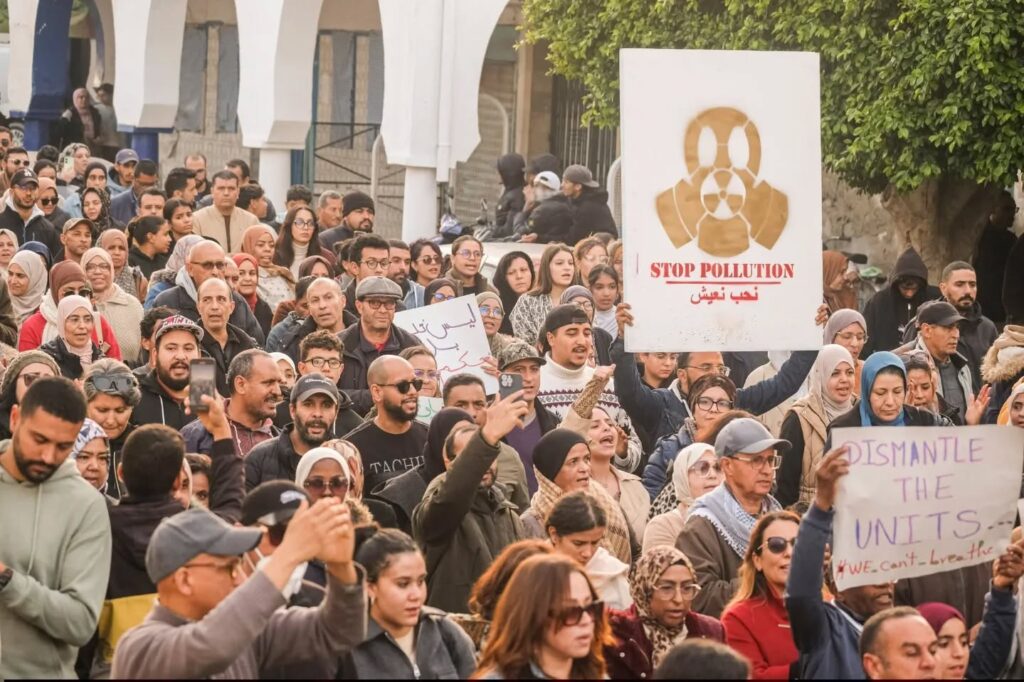
With the opening of new spaces for discussion, mobilisation intensified after the 2011 revolution. The inhabitants of Gabès organised themselves into grassroots movements and collectives, including the well-known Stop Pollution. ‘We are a group of citizens who have been fighting against the GCT since the revolution,’ explains activist Khayreddine Debaya. ‘We chose a horizontal structure, without formally forming an association, in order to remain independent from external funding and free from any exploitation. We represent the citizens.’ This choice allowed the movement to avoid being caught up in the wave of judicial investigations in 2025 into foreign funding of civil society associations.
In 2017, before Kais Saied’s coup in 2021, strong mobilisations prompted the authorities to promise to dismantle the most polluting plants and end the discharge of phosphogypsum into the sea. The ministerial decision of 29 June 2017 provided for compliance with international environmental standards and the relocation of the production site. However, these commitments remained unfulfilled and the facilities deteriorated further. Since then, the GCT has continued to operate day and night, and accidents have multiplied. In January 2019, for example, several videos showed orange smoke and bicarbonates escaping from a chimney, followed by residents falling ill.
A new mobilisation with historical roots
Since the beginning of October 2025, a historic wave of protests has once again shaken Gabès. The cause: the hospitalisation, this time, of more than 310 people for GCT gas poisoning. On social networks, videos of children suffering from dizziness and illness in overcrowded hospitals have gone viral, prompting thousands of citizens to take to the streets. On 21 October, the regional branch of the Tunisian General Labour Union and local associations called a general strike. The entire city came to a standstill: more than 100,000 people took to the streets, according to Stop Pollution, in what could be the largest environmental mobilisation in the country’s history.
‘The people want the factories dismantled!’, ‘Breathing is a right,’ ‘We are not Chernobyl’ and other slogans chanted at the demonstrations, which were suppressed by the police. On 20 October, the Tunisian League for the Defence of Human Rights (LTDH) denounced the ‘use of security repression to stifle protest movements,’ recording 89 arrests, including 20 minors.
At the same time, local actions against green hydrogen projects in Tunisia have developed in recent years. ‘Stop anyone on the street in Gabès and they will talk to you about green hydrogen,’ says Khaireddine Debaya. ‘Installing the pilot project in Gabès has strong symbolic value and is a serious mistake. Here, we are already organised, trained and aware of the consequences of new destructive projects.’ From activists to ordinary residents, the issue of green hydrogen has even reached the stands of the Avenir Sportif de Gabès (ASG) ultras, who are now involved in environmental demonstrations.
In April 2024, a group of activists gathered in front of the German cooperation headquarters in Tunis on World Anti-Colonialism Day, responding to the call of local associations, trade unions, parties and pro-Palestinian activists. GIZ, the main foreign partner of the Ministry of Mines and Energy, was criticised for its programme, which was described as “neo-colonial”, and accused of driving the green hydrogen strategy in Tunisia.
A year later, in May 2025, a local demonstration brought together several hundred people in Gabès to protest against “neo-colonialism and energy plundering”. Various sections of the population – young people, pensioners, workers, ultras – expressed their concern: “Green hydrogen adds to the mountain of problems we have in Gabès, so why increase the burden?”.
In addition to primarily serving European needs, the “green hydrogen valley” could have serious consequences for the environment, especially due to the large quantities of water required. Supporters assure that only desalinated water and treated wastewater will be used, thanks to a Japanese plant capable of processing 6,000 m³ per day, but the ecological impact raises doubts. International studies show that desalination is more polluting and expensive than expected: two litres of seawater are needed to produce one litre of desalinated water. The resulting brine, often chemically treated, becomes toxic, worsening marine pollution and increasing the water temperature, which is already high in Gabès due to GCT contamination.
A video released by the Tunisian presidency on 1 October 2025, after the first wave of hospitalisations, questions the official position. Kais Saied blamed the lack of maintenance of the GCT and recalled that before the 2019 elections he had met with movements in Gabès that propose local solutions and “reject green hydrogen”. At the end of September, the President denounced the “murder” of the environment in Gabès, calling half a century of industrial policy a “crime”, while defending the revival of phosphate production as an economic pillar of the country. Just a few months earlier, in fact, the government announced its goal of increasing production fivefold by 2030.
Faced with the protests of October 2025, the government brought the GCT issue back to the table. Tunisia would be ready to rely on China to modernise the GCT units, filter emissions and reduce pollution. Wan Li, Chinese Ambassador to Tunisia, recently confirmed this information to the Tunisian media. However, the modernisation of outdated facilities does not respond to the movement’s main demand, which is to “dismantle the production units” of the GCT. After years of broken promises, the protesters now refuse to accept any compromise. Their demand for dismantling has a precedent in Tunisia: in 2019, the government permanently closed SIAPE, the Tunisian producer of TSP (a concentrated phosphate fertiliser), after twenty years of protests in the city of Sfax. The plant emitted acid fumes similar to those in Gabès and produced phosphogypsum.
Today, the definition of “green transition” promoted by government and industry rhetoric — which aims to finance the green hydrogen pilot project and implement exports even before addressing the local health and environmental crisis — appears increasingly distant from the expectations of a unanimous and opposed citizenry. In Gabès, even the issue of employment has given way to ecological demands: on the streets, there is only one goal, the preservation and habitability of a sacrificed territory.